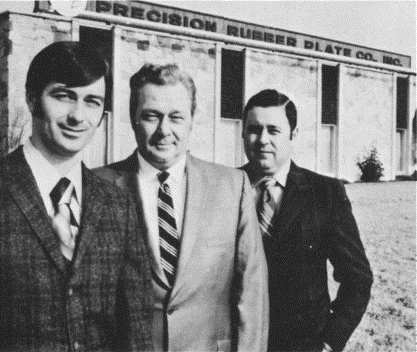
Indiana firm using photopolymer pattern plates for deep-relief printing dies
Of all the advances made in corrugated packaging, the trend to flexographic printing has been both dramatic and dominant. Efforts to further improve the quality of flexo printing are continuing on many fronts by materials suppliers, press builders, platemakers and ink manufacturers alike.
One approach has been the use of Dycril photopolymer pattern plates for the production of deep relief rubber printing dies.
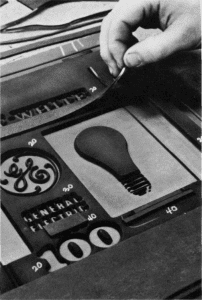
In commenting on the demand for better graphics on corrugated pack- ages, Manuel Green, founder and presently presidents general manager of Precision Rubber Plate Co., Inc., Beech Grove, Indiana stated, “We had been making plates for multicolor line printing on corrugated right from the start, but in the late sixties it became apparent that there was a market for us in half- tone multicolor as well. At first we used zinc for our pattern plates but zinc engravings had undesirable rough shoulders on the dot and if that rough shoulder was reproduced in a resilient plate, compression of the dot, in printing, gave it a ragged appearance.
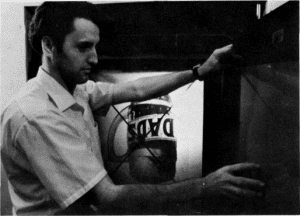
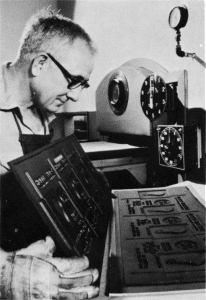
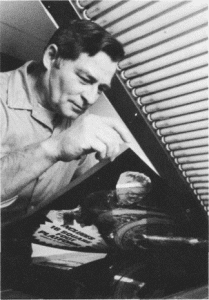
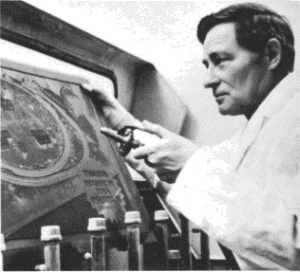
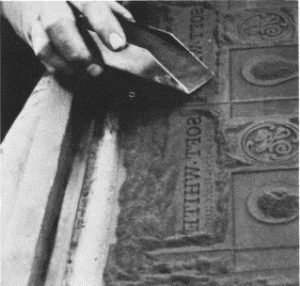
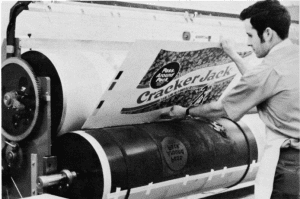
“When the plates were etched to the necessary depth for our molds, the dot would frequently be so undercut that the plate could not be removed from the Bakelite mold. Both of those problems were eliminated when we started using Du Pont’s Dycril plates. The dots were clean and sharp with no undercut- ting and the Bakelite masters separated from the Dycril quite easily.” Dycril type 250 photopolymer pat- tern plates are deep relief (150 mils) plates designed specifically for the making of Bakelite masters which are then used to mold rubber printing plates. Dycril is exposed through a negative, under vacuum, by either a carbon arc or the Du Pont black light flat exposure unit. After exposure the plate is washed out in automatic equipment using a high pressure spray of weak alkaline solution. A short post exposure to the same light source hardens the ex- posed areas of the plate and it is ready for making the Bakelite master mold. Precision Rubber Plate Co. keeps four Platemaster molding presses busy turning out master molds. The company has installed, and modified, Opti-Chek mounting and proofing machines so that the customer gets a full size, full color, proof on exactly the same type of corrugated board that he will use in his production run. That proof, when slot- ted and assembled, shows the customer what his package will look like
Family Business
Precision Rubber Plate, despite changing times, is proof that a family run business is not dead. Manuel Green credits much of his success to the industry and enthusiasm of his sons, Larry and Jim. Like the biblical bundle of sticks the company draws much of its strength from family involvement.
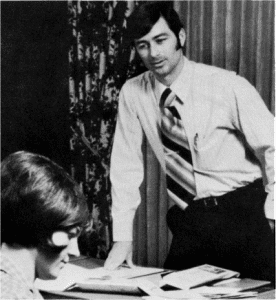
In today’s social climate where sons are more inclined to do-their- thing rather than follow in their father’s footsteps, the Green family is an exception in that the sons in- sisted upon joining the company. Son Jim, is vice president in charge of sales while Larry, production vice president and an instrument rated pilot, flies a Beech Baron on urgent customer calls.
On March 1, 1938, Manuel Green opened his one-man shop in down- town Indianapolis. His one product was hand engraved rubber printing plates. The company now employs fifty-two people at its new, modern facility in Beech Grove and an average staff of twenty at its satellite plant in Atlanta.
In commenting upon the progress of the company, the founder reflected, “From hand-cut rubber block plates, we expanded into molded flexographic plates and ultimately concentrated most of our efforts toward the development of resilient plates for printing on corrugated. By 1950 we had expanded to the point where I was making sales calls and demonstrations. At first this was mostly a local effort, but by 1953 we were going farther afield and picking up national ac- counts. By 1964 we began making flexo halftone plates.”
“Because we make so many large rubber plates for printing displays”, explained Mr. Green, “we still keep several men busy at hand cutting. But all of the photographs and other fine art go on Dycril.”
Unhappy with reproduction from standard plate rubbers, the Greens developed their own composition, Corrotone, which reduced dot spread on the hard ridges of corrugated board.
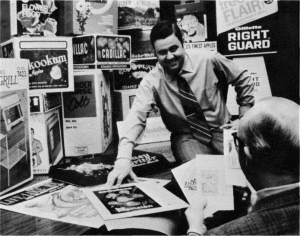
“Whenever possible, on a new account,” comments Larry Green, “one of us will visit the client, and advise him as to art requirements for corrugated. Even though we supply him with a full size package proof, we often feel the necessity to personally put our plates on his press, set his form roll and show him where he needs to keep both his impressions and ink as light as possible. We’ll run the job and the next time he’ll be o.k.
“We’d like to do more of this type of training because there are many young fellows running corrugated presses who just don’t have the necessary know-how. But with our limited staff we can’t cover all of them, so we often invite the client to our plant for demonstrations. Subsequent follow-up by phone and then a visit to his operation for a press run leaves him with a much better understanding of the techniques of turning out first class printing on corrugated packages.”